

Giza · Stop 4 of 5
Great Sphinx of Giza
أبو الهول
When you are there
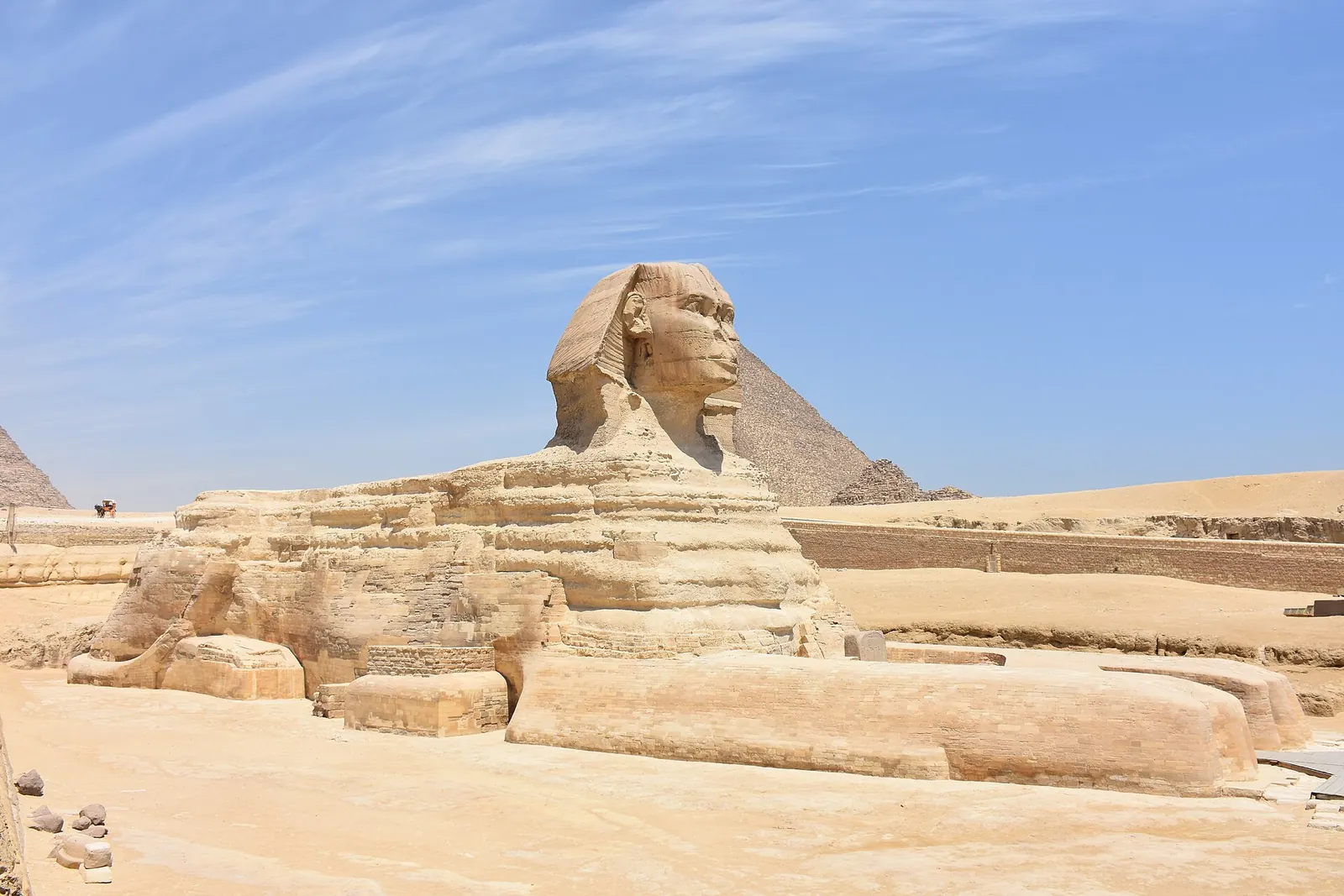
- Look at the giant lion lying down, with a human head, facing east
- Look at the face: someone broke the nose on purpose
- In front: the stones of a temple that was never finished
Great Sphinx of Giza.
The Great Sphinx is a giant statue of a lion lying down, with the head of a human. It was carved straight out of the rock of the Giza Plateau, and it faces east. It is the oldest known large sculpture in Egypt.
It is huge: 73 metres long from paw to tail, and 20 metres high. Experts think it was made between 2600 and 2500 BC, for Pharaoh Khufu or his son Khafre. But whose face it shows is still debated. No inscription from that time connects the Sphinx to a king.
Nobody knows its first name. Much later, people worshipped it as a sun god called Hor-em-akhet, "Horus of the Horizon". The name "Sphinx" came from the Greeks, about 2,000 years after it was made. In Egyptian Arabic, it is called Abu al-Hawl, "the father of terror".
And what happened to the nose? Nobody knows for sure. Studies of the face show that someone broke it on purpose, with rods or chisels. A popular story says that Napoleon's soldiers shot it off with a cannon in 1798. That story is not true.
How was it made? The Egyptian geologist Farouk El-Baz has an idea. He thinks the wind first shaped a ridge of rock, and the head was carved from it. Later, workers cut away the rock around it to make the body. They used those stones to build a temple in front of the Sphinx. But the temple was never finished.
Quick facts
- About 73 metres long and 20 metres high
- Carved from the rock of the Giza Plateau
- Made around 2600 to 2500 BC
- Arabic name Abu al-Hawl: "father of terror"
Visit tips
The Sphinx is on the Giza Plateau, close to the pyramids. Check ticket prices and opening hours before you go. The Giza Plateau is large and has little shade, so bring water, a hat and sun cream.