

The New Town and Calton Hill · Stop 3 of 5
Dugald Stewart Monument
Dugald Stewart Monument.
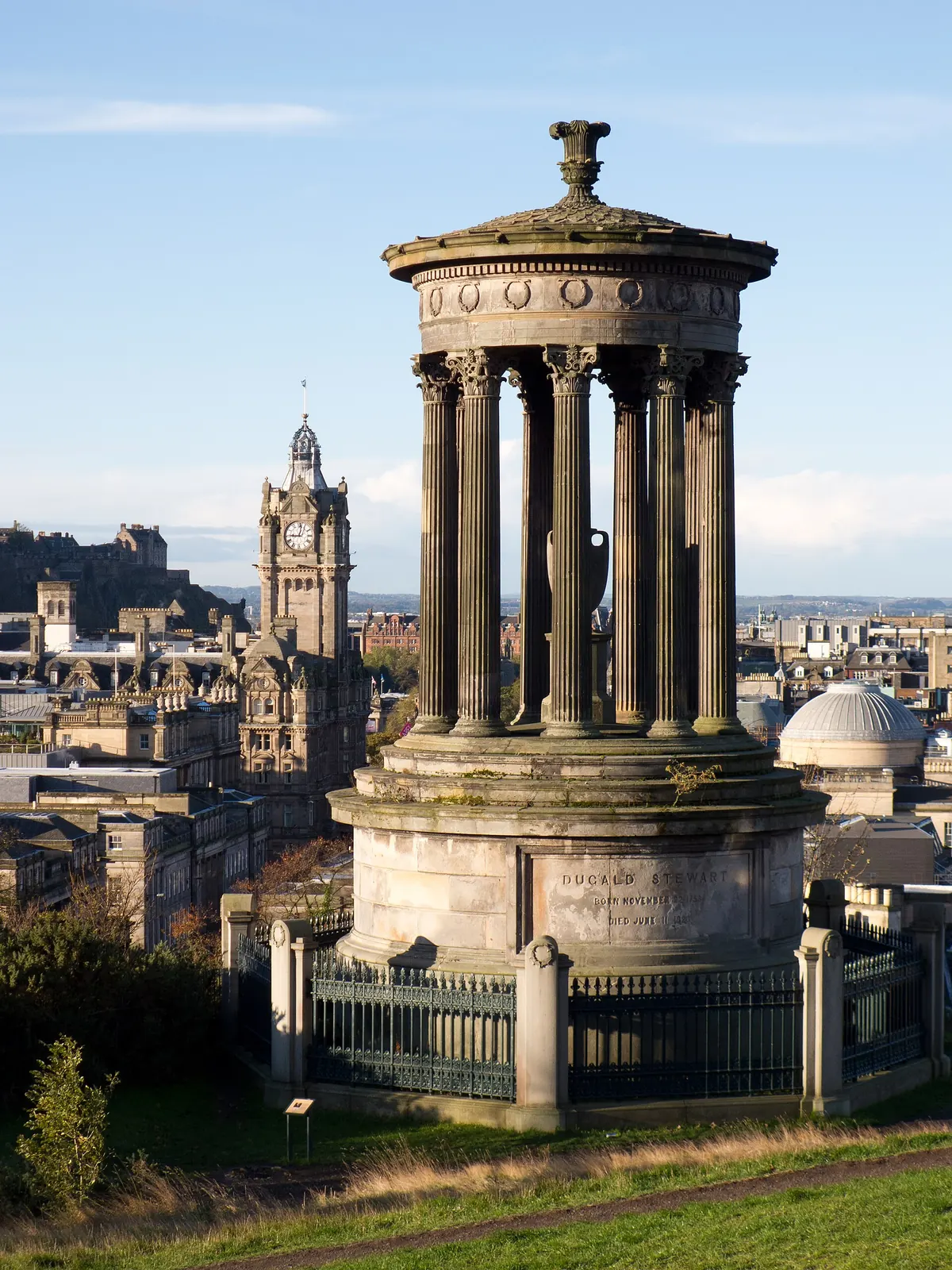
This round temple of stone columns looks as if it came from ancient Greece. In a way, it did.
It remembers Dugald Stewart, a philosopher of the Scottish Enlightenment, a time when Edinburgh was full of new ideas about science and thinking. Stewart was born in 1753 in the university's Old College, where his father taught mathematics. He later became professor of moral philosophy, the study of how people think and how they should live. His books helped make "Scottish philosophy" well known across Europe in the early 1800s. Many of his students became famous too, among them the writer Sir Walter Scott, the thinker James Mill and the future Prime Minister Lord Palmerston.
Stewart died in 1828. The Royal Society of Edinburgh asked the architect William Henry Playfair to design a monument for him, and it was finished by September 1831.
Playfair copied a monument in Athens, the Choragic Monument of Lysicrates. A rich man named Lysicrates built it after a boys' choir that he paid for won a prize at a festival in 335/334 BC.
Look at the nine fluted (grooved) Corinthian columns standing in a circle around an urn, a tall stone vase. On the north-east side, the words give Stewart's dates of birth and death.
Then turn around. Views from Calton Hill appear in many photographs and paintings of Edinburgh, often with this monument at the front.
Quick facts
- 1831Finished by September
- Designed by William Henry Playfair
- Copies a monument built in Athens in 335/334 BC
- Nine fluted Corinthian columns around a stone urn
Visit tips
Free to see from the paths on Calton Hill. It can be windy at the top, so bring a jacket. Allow about 10 minutes.