
Glasgow Necropolis.
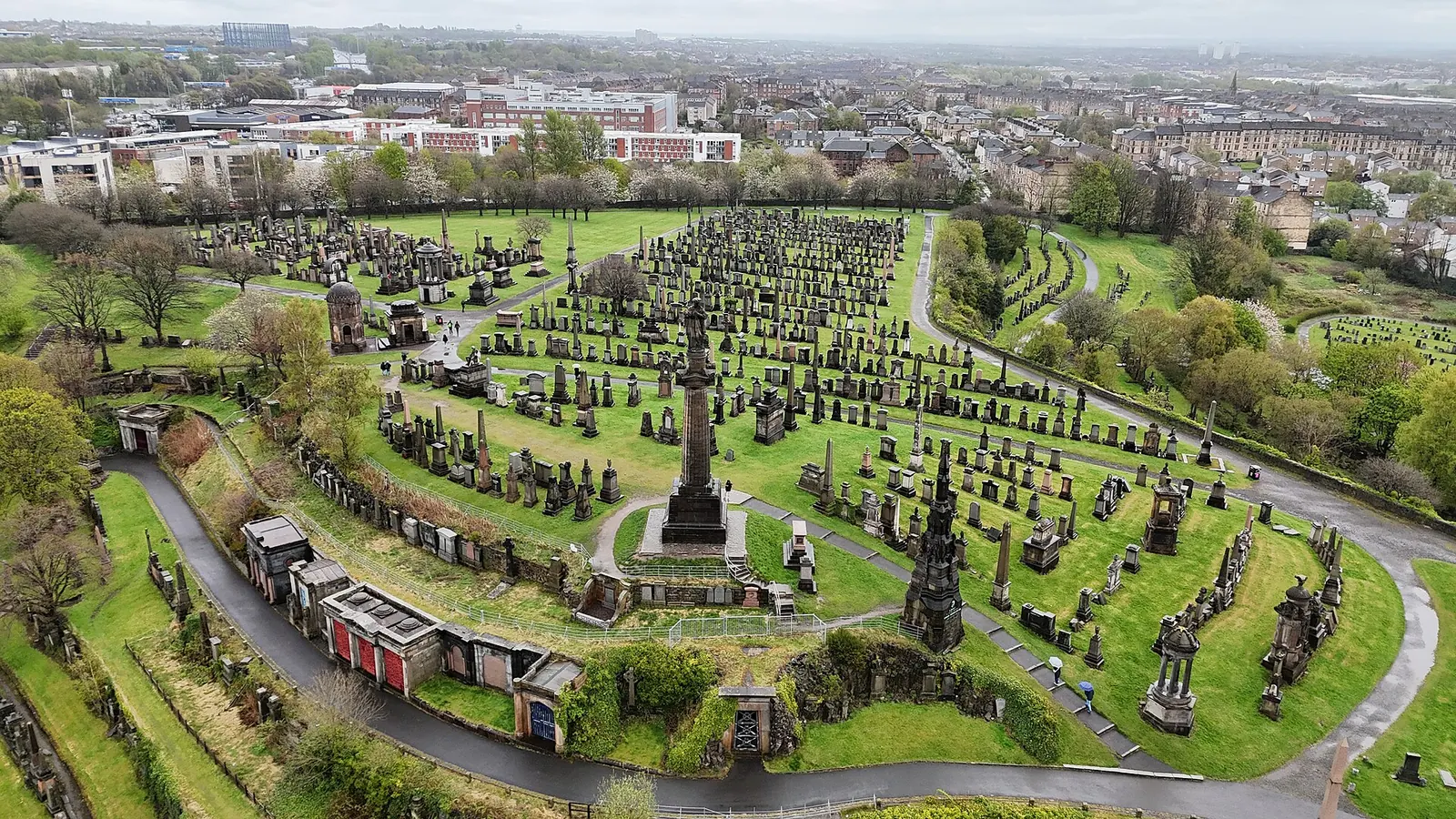
Behind the cathedral, on a low hill, is the Glasgow Necropolis, a Victorian garden cemetery. Its name means "city of the dead". Fifty thousand people are buried here, and there are around 3,500 monuments.
The idea came from Père Lachaise Cemetery in Paris. Until then, churches buried the dead. The Merchants' House of Glasgow began planning a cemetery in 1831, the law was changed in 1832, and the Necropolis opened in April 1833. Just before that, in September 1832, a small Jewish burial ground opened here.
You enter over a bridge built in 1836. Funerals crossed it, so people called it the "Bridge of Sighs", like the bridge in Venice.
The paths are not in straight lines. They wind uphill like a park, to the top, where many of the largest monuments stand. They are grouped around a statue of John Knox on a tall column. It is older than the cemetery: it dates from 1825.
The comedian Billy Connolly said that Glasgow "doesn't care much for the living, but it really looks after the dead".