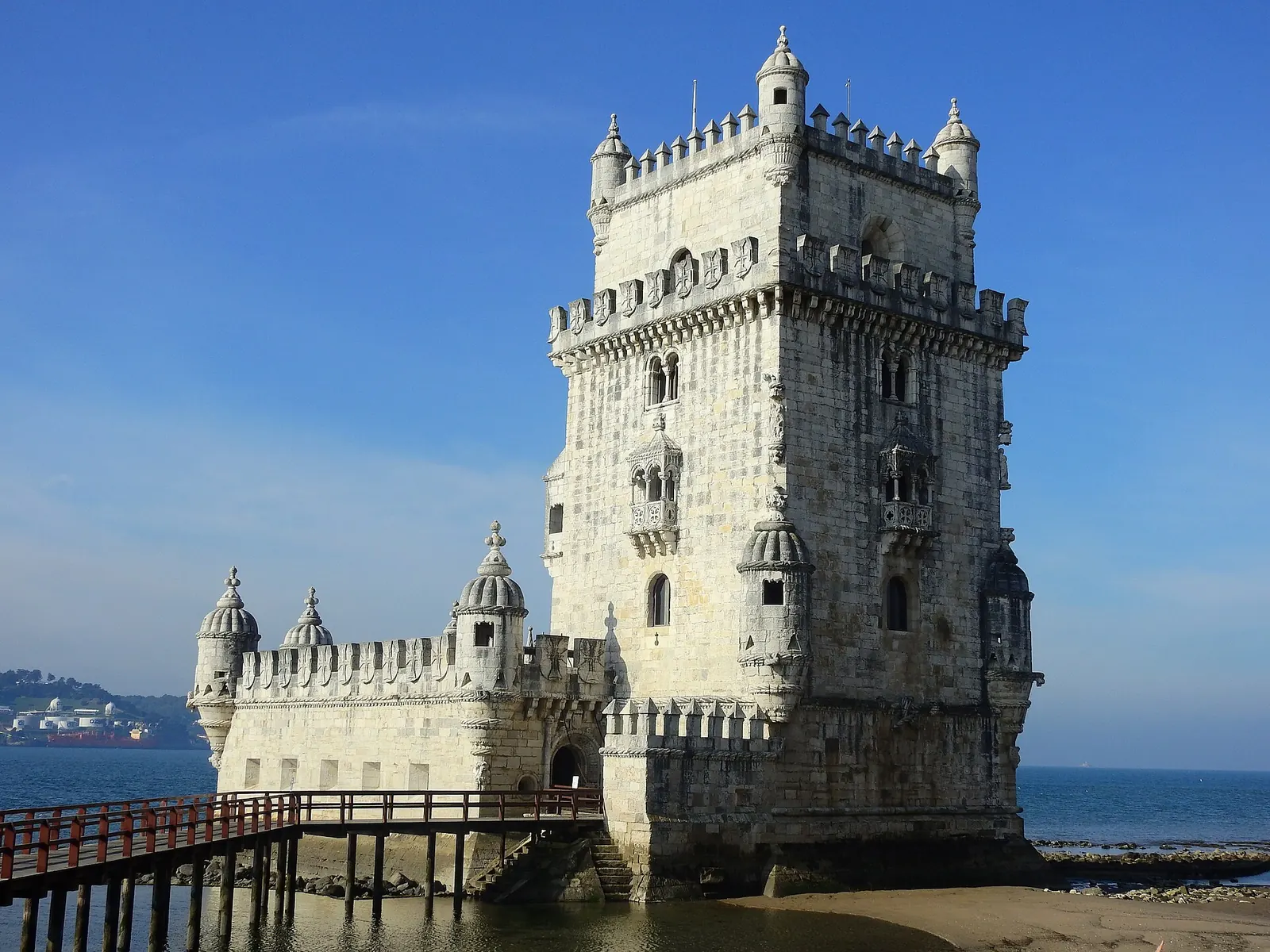


Belém Tower.
Belém Tower guarded the entrance to Lisbon from the river. It was also a ceremonial gateway, where Portuguese explorers left and returned.
King John II first planned a strong fort here in the late 15th century, but he died before it was built. Twenty years later, King Manuel I took up the idea again. The military architect Francisco de Arruda designed the tower, and it was finished in 1519. While it was being built, a large armed ship guarded the river mouth.
The tower is built of lioz, a local limestone, and it stands 30 metres tall, with four floors above a bastion. It is a fine example of the Manueline style, but its small turrets were inspired by Moorish buildings.
Look for a small stone rhinoceros on the outside. An Indian ruler gave a real rhinoceros to King Manuel, and the artist Albrecht Dürer later drew the same animal.
People often say the tower was built in the middle of the river, and the river moved after the 1755 earthquake. That is not true: it was built on a small island close to the shore.
Later, its dungeons were used as a prison until 1830. Since 1983, it has been a UNESCO World Heritage Site.