
Palaces and Hanok Houses · Stop 3 of 4
Bukchon Hanok Village
북촌 한옥마을
When you are there
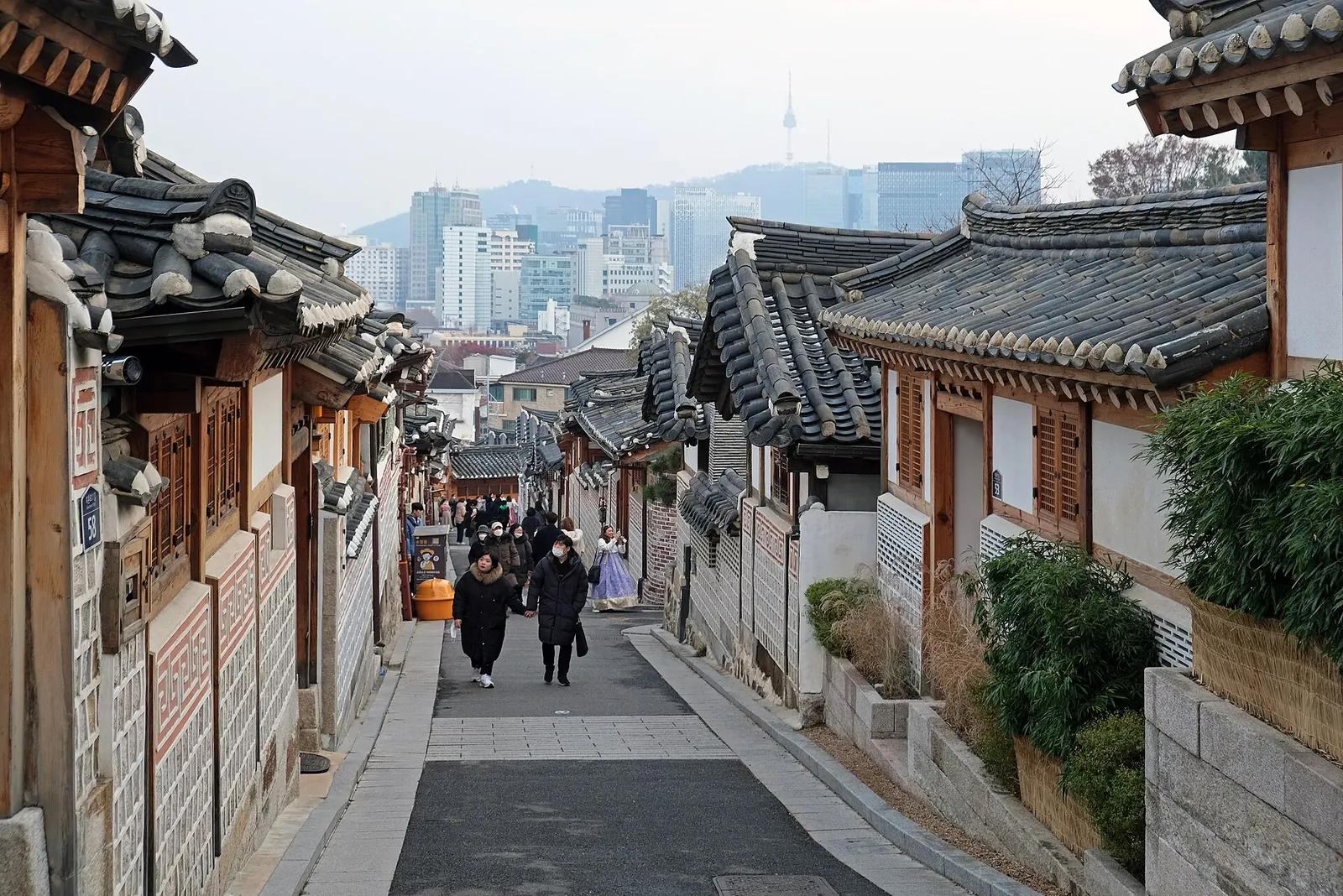
- Walk up the sloping lanes past rows of hanok (traditional Korean houses)
- Look at their tiled roofs, wooden frames and glass windows
Bukchon Hanok Village.
Walk up these sloping lanes and you will see rows of hanok: traditional Korean houses with tiled roofs and wooden frames. Bukchon means "north village", because it lies north of the Cheonggyecheon stream and the Jongno street.
In the time of the Joseon kings, this was where high officials and noble families lived, close to the palaces.
Most of the houses you see date from the late 19th and early 20th centuries. Many were built by one man, Chŏng Segwŏn. Around 1920, during Japanese rule, he started the first Korean-owned modern property company. His family says he built here on purpose, so that the area would not be taken over by Japanese settlers. He chose to build hanok, not Japanese-style houses. He gave them glass windows and electricity, and made them smaller, so that ordinary Koreans could afford them. He used his money to support the Korean language. Later the colonial government punished him and took much of his property.
From the 1970s, rules protected the area, and the hanok were saved from the new buildings rising all over Seoul.
Remember that this is not a museum. Around 6,100 people live here, and 6.4 million tourists came in 2024. Please speak quietly and respect people's homes.
Quick facts
- Bukchon means "north village"
- Many hanok date from the late 19th and early 20th centuries
- Once home to high officials and nobles
- 20246.4 million visitors, but only about 6,100 residents
Visit tips
People live here: keep your voice low, do not enter private homes, and keep groups small. Tourists may only enter between 10 a.m. and 5 p.m. unless they are staying in a local guesthouse.