

Palaces and Hanok Houses · Stop 1 of 4
Gwanghwamun Square
광화문광장
When you are there
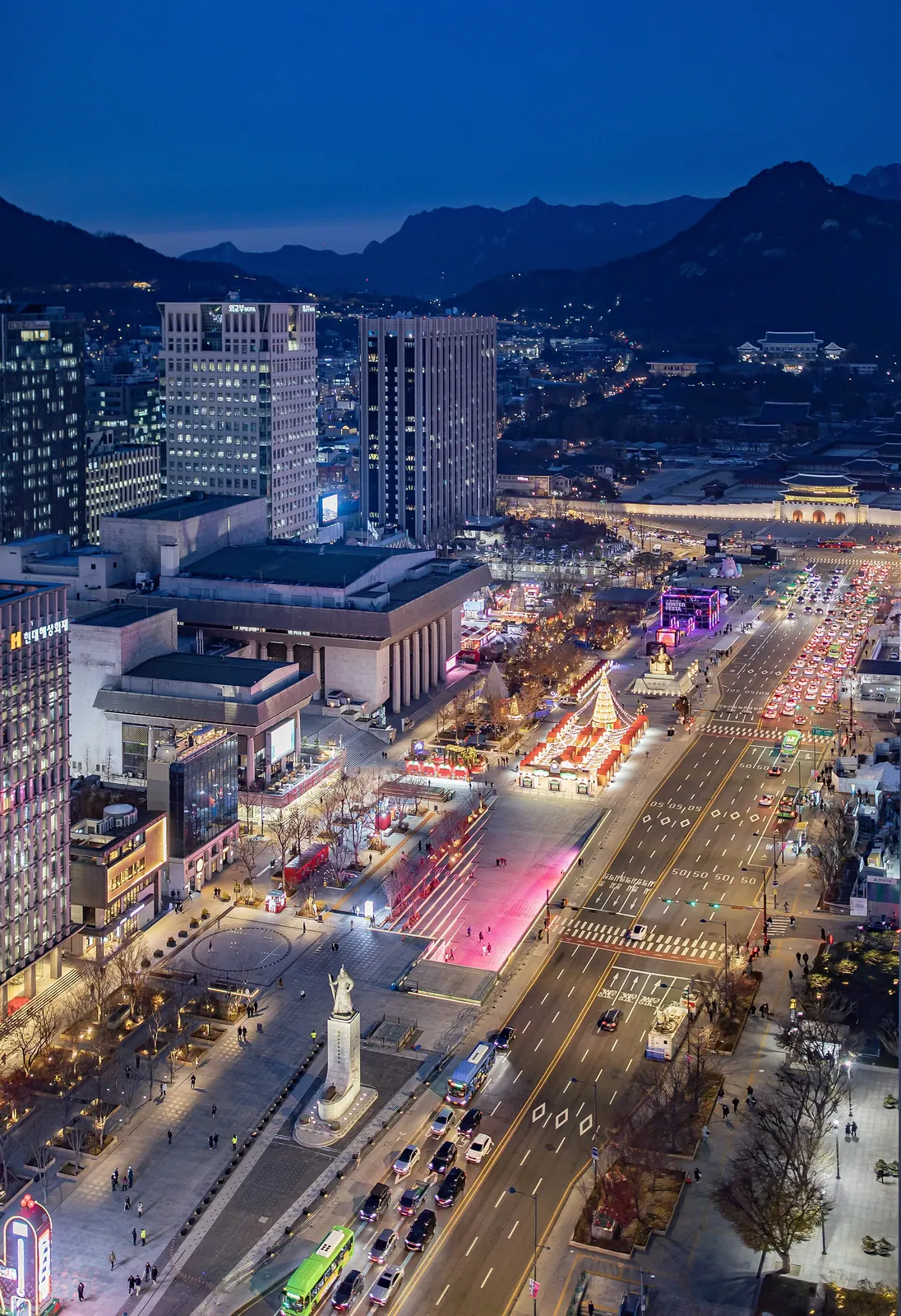
- At the south end: Admiral Yi Sun-sin, with the 12.23 Fountain beside him
- Further north: King Sejong the Great, a bronze statue 6.2 metres high
- Along the east side: a water channel with 617 stones of Korean history
Gwanghwamun Square.
This long square leads up to the main gate of Gyeongbokgung, the first royal palace of Seoul. In the time of the Joseon kings, it was the centre of the city. The six ministries of the royal government had their offices along this street, so it was called the Street of Six Ministries.
In the 20th century the street became a road with 16 lanes of traffic. In 2009 it was turned into a square for people, and in 2022 it was made more than twice as big again. On opening day, the square was covered with a carpet of 224,537 flowers, one for every day since Seoul became the capital in 1394.
Two great Koreans watch over the square. At the south end stands Admiral Yi Sun-sin, put up in 1968. He fought the Japanese invasions of 1592 to 1598. The fountain beside him is called the 12.23 Fountain: he fought 23 battles with just 12 warships.
Further north sits King Sejong the Great, a bronze statue 6.2 metres high. Sejong invented Hangul, the Korean alphabet, and the statue was unveiled on Hangul Day in 2009. Underneath the two statues is a small free museum about both men.
Along the east side, a shallow water channel has 617 stones that record events in Korean history.
Quick facts
- Once the Street of Six Ministries
- 2009Opened as a square, enlarged in 2022
- Statues of Admiral Yi Sun-sin and King Sejong
- King Sejong invented the Korean alphabet, Hangul
Visit tips
A public square, free and open at all times. Smoking is not allowed here. The museum under the statues has its own opening hours; check before you go.