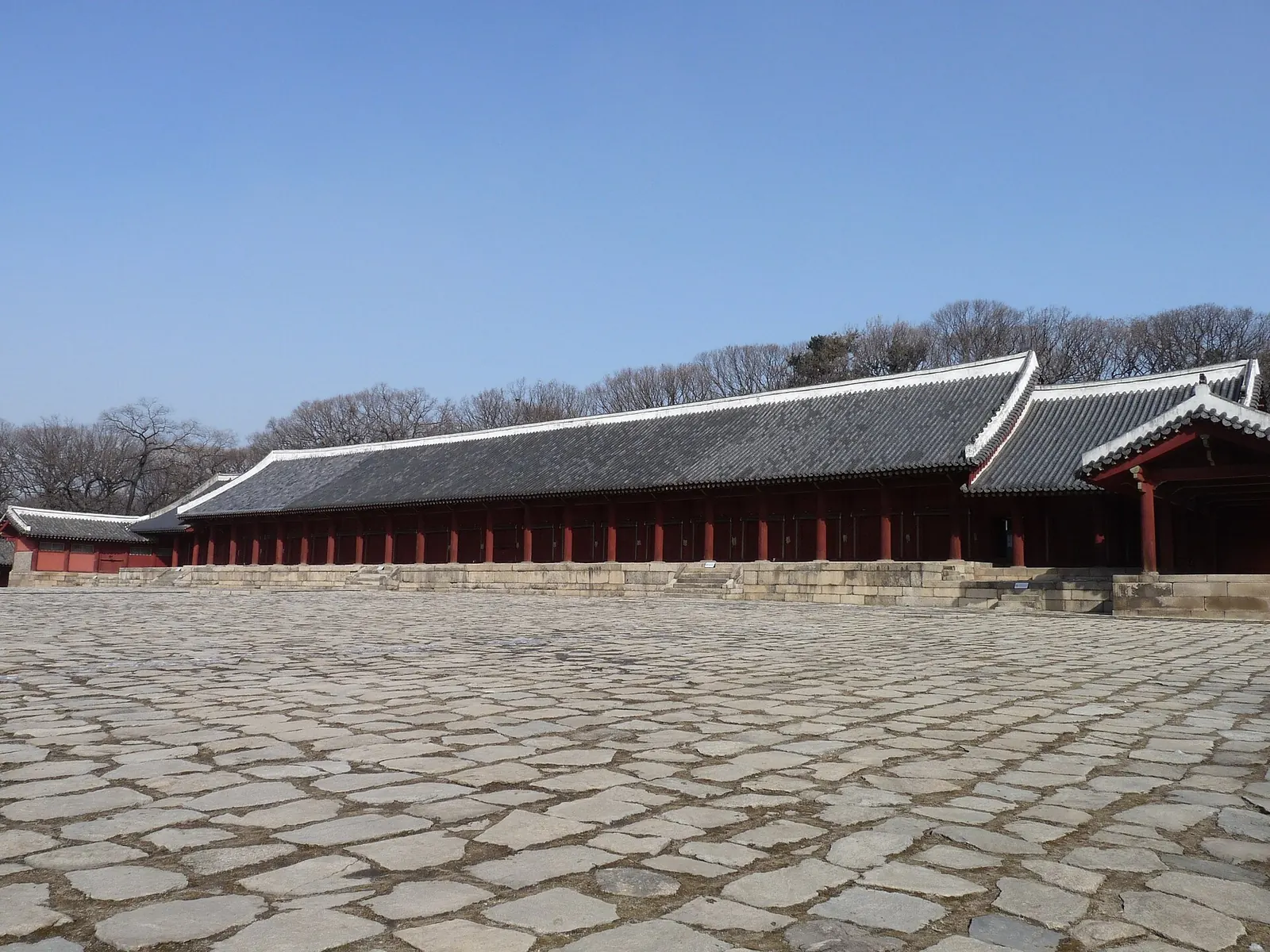


Jongmyo.
Jongmyo is a quiet place of great respect. It is the shrine where the Joseon kings and queens are remembered, following the teachings of Confucius. Here, the spirits of the dead are honoured with ceremonies.
King Taejo, the first Joseon king, built it in 1394, when he made Seoul his capital. At the time, it was thought to be one of the longest buildings in Asia. The main hall, the Jeongjeon, has a row of simple rooms. Each one holds the spirit tablets of a king and his queens. A tablet was placed here three years after a king's death, at the end of the time of mourning. As more kings died, the hall grew longer and longer.
In the Japanese invasions of 1592 to 1598, the shrine burned down. But the tablets were saved: people hid them in the house of an ordinary family. The shrine was rebuilt in 1601, and that building still stands. Today the Jeongjeon is the longest traditional building in Korea and a national treasure.
There are three gates. The south gate was for the spirits, the east gate for the king, and the west gate for the musicians and dancers.
Every year, descendants of the royal family hold the Jongmyo Daejae, a great ceremony with ancient music, as it has been done since the 14th century. Jongmyo became a UNESCO World Heritage Site in 1995.