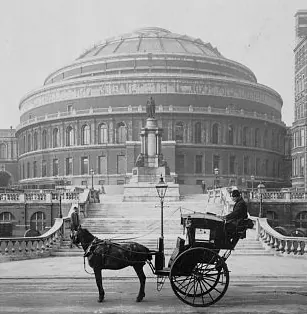


Royal Albert Hall.
The Royal Albert Hall is a round concert hall with seats for 5,272 people. It is a memorial to Prince Albert, the husband of Queen Victoria.
After the Great Exhibition of 1851 in Hyde Park, Albert wanted to build a group of places for the public good here. People called it "Albertopolis". But Albert died in 1861, before he could see his plans come true. A memorial in the park was proposed, with a great hall opposite it. The hall was to be called the Central Hall of Arts and Sciences. When Queen Victoria laid the first stone in 1867, she changed the name in memory of her husband.
The designers were inspired by ancient amphitheatres. The hall is built mainly of red brick, with decoration in terracotta. Its iron and glass dome was first put together in Manchester as a test, then taken apart and brought to London by horse and cart. When the supports under the dome were taken away, only volunteers stayed inside, in case it fell. It dropped by just 7.9 millimetres.
The Queen opened the hall on 29 March 1871. She was too moved to give a speech herself. At the first concert, everyone noticed a strong echo. People joked that it was the only place where a British composer could be sure of hearing his work twice.
Since then, the world's great performers have appeared here. The BBC Proms concerts have been held here every summer since 1941. Look across the road to the north to see the Albert Memorial, the next stop.